
Echolocation
How does a tiny bat manage to dive quickly in total darkness and hunt a tiny insect while flying?
While the eyes are dominant in the heads of nocturnal birds of prey, suggesting the existence of a highly developed sense of sight, insect-eating bats have relatively small eyes. How do they manage to do this? Perhaps the small eyes have especially developed visual ability?
Lazzaro Spallanzani (ˈladdzaro spallanˈtsaːni) was a Catholic priest, physiologist, and biologist who contributed greatly to the life sciences. He was among the first to refute the idea of preformism, and among other things he carried out in 1790 an experiment that marks the beginning of the path to deciphering the secret of bats. Spallanzani designed a room in which many wires were stretched. He released blindfolded bats to fly around the room, examined how they coped with the obstacle, and found that even when their eyes were disabled they managed to avoid the wires, that is: they do not rely on sight for orientation.
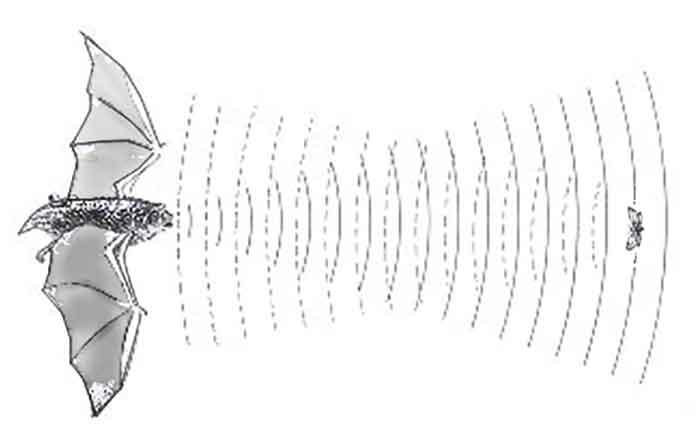
It would be many years before the mystery was solved, thanks, of course, to wars and to Americans. In the 20th century, technologies were developed that made it possible to decipher the secret of bats, and in 1944 an American zoologist coined the term, Prof. Donald Griffin, for the term "echolocation". It turns out that bats use very high-frequency sound waves, usually higher than we can hear, in order to navigate, hunt, and communicate. They produce the ultrasonic waves in the throat and transmit them outward through the mouth or nose. Waves that strike some object return to the bat, and from them the bat assembles an 'image' of the surroundings. In fact, one can say that bats "see with their ears," as Dr. Brock Fenton (Brock Fenton, Phd) describes it. On the University of Bristol website an interactive demonstration of echolocation. Below are some very basic concepts, the clarification of which is essential for reading additional content on the site. Since the species pages frequently mention sound frequencies, for example, it is necessary to describe the concept of "frequency." However, we have settled for rather simplistic descriptions: anyone interested is invited to consult additional sources - online and in the literature, mentioned on the links page.
The discussion in this chapter is devoted to bats, but echolocation is also known in other groups in the animal world, including marine mammals. In each group, the ability evolved in accordance with the lives of the species and the environment in which they live. Although humans, for the most part, do not use sound as a means of orientation, the following video is an example of this:
The information bats extract from sound waves is not limited to the distance to a target object. Bats are able to identify many details in space and assemble a fairly complex image. While measuring the range to the target is made possible by measuring the time elapsed from the moment the wave is transmitted until its return, when it comes to direction the challenge is greater, especially considering the bats' small size: the time differences between reception of the signal by the two ears are extremely small.
Sound waves
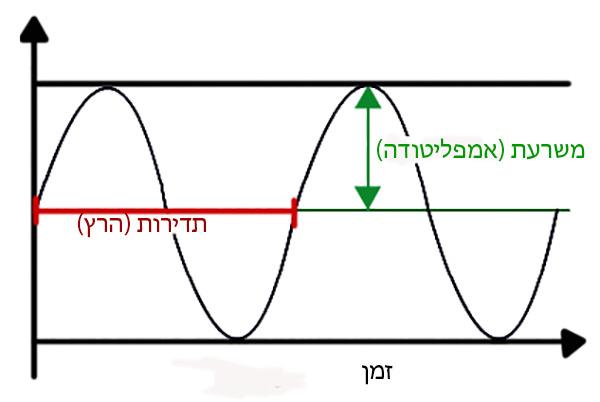
Sound waves can be described as the propagation of "pressure waves" in space, whose movement changes according to the medium in which they travel. One of the concepts heard frequently in the context of bat observation is frequency, which can be measured thanks to the periodic property of sound: the time it takes for one wave cycle.
The unit of measurement for frequency is hertz (Hz). Bats use especially high sounds, so we will use kilo (=1000) hertz (kHz). The accompanying diagram is two-dimensional, extremely simplistic, intended to illustrate the mentioned concepts.
Why don't we hear them?
The human ear and the human brain receive and process only a small part of all the sounds that reach them from the environment.
In general, humans hear sounds whose frequency ranges between 20-20000 Hz. That is, we hear sounds that complete at least 20 cycles per second, and at most 20 thousand cycles per second. Bats often use ultrasonic sounds, meaning: if we describe them in the diagram above, they complete more than 20000 cycles per second. There are vertebrate species whose hearing range extends into the infrasonic range: pigeons and elephants, for example, are able to hear very low sounds whose frequency is only a few Hz.
How are ultrasonic sounds heard?
There are several methods for converting the ultrasonic signal into the audible range. If we want to examine the sound wave with software, there may be no need to listen at all: we can record the signal and then examine the result with a computer. If we want to listen to bats in the field, we need to use a device that translates the ultrasonic signal into the audible range: bat detector.
What are CF sounds?
What are FM sounds?
Can bats distinguish between sound waves they transmitted themselves and those transmitted by their peers?
Can insects hear bat sounds?
What is a spectrogram?
What do bats have to do with bandwidth?
What is the connection between sound frequency and habitat?
How does a bat detector work?
What are the advantages of transmitting sound waves through the nose?
Can a glass cup be broken by shouting?
And more - in the following lists