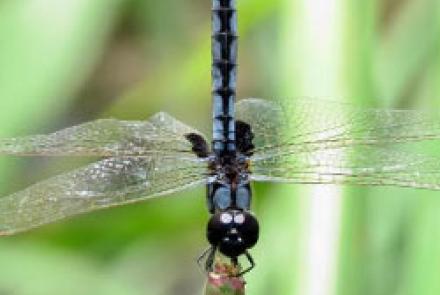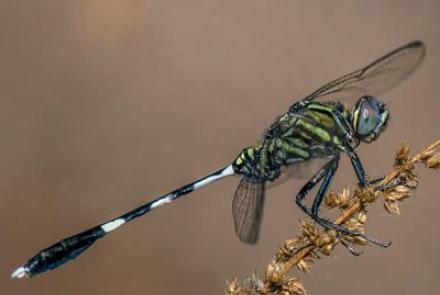

Mosaic Hawker Aeshna mixta
English name: Migrant Hawker.
Unlike the other members of the hawker family, the Mosaic Hawker is not territorial, and in Europe it can even be seen hunting in flocks.
Size: medium (5-6 cm).
Habitat: lays eggs in still water or slowly flowing water, usually with reed beds along the edges.
Sometimes seen far from water and even at forest edges.
Often rests in low vegetation.
Distribution: in most of Europe and Asia, as well as North Africa.
Rare in the country.
Season: a dragonfly characteristic of late summer and autumn: July-mid-November. Occasionally, individual specimens are seen as early as mid-May. (According to data from Turkey).
Identification marks:
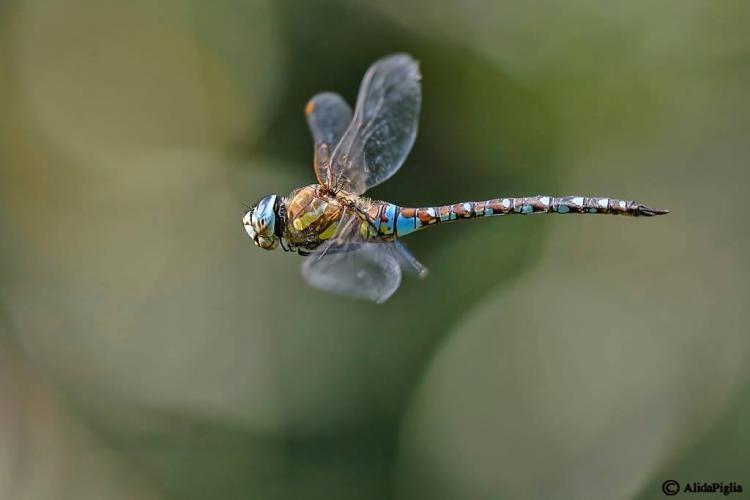
The abdomen is brown with pairs of blue and yellow spots from the third segment onward. The second segment has a yellow T-shape (diagnostic mark).
The brown thorax has two short yellow shoulder stripes, as well as two yellow stripes on the sides of the thorax.
The eye is blue.
The costa (the leading edge of the wing) is brown.
Young males and females are similar but slightly duller (the females are duller than the young males).
The male's appearance is unique and should not be confused with any other local species. But at a glance the female may appear similar to the female of River Watcher.
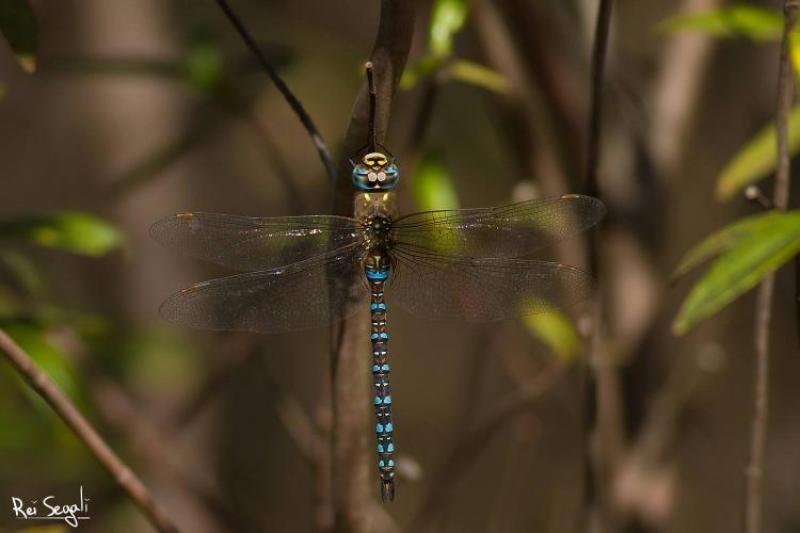
The T-mark on the second abdominal segment, and the pattern of blue and yellow spots, can be seen.
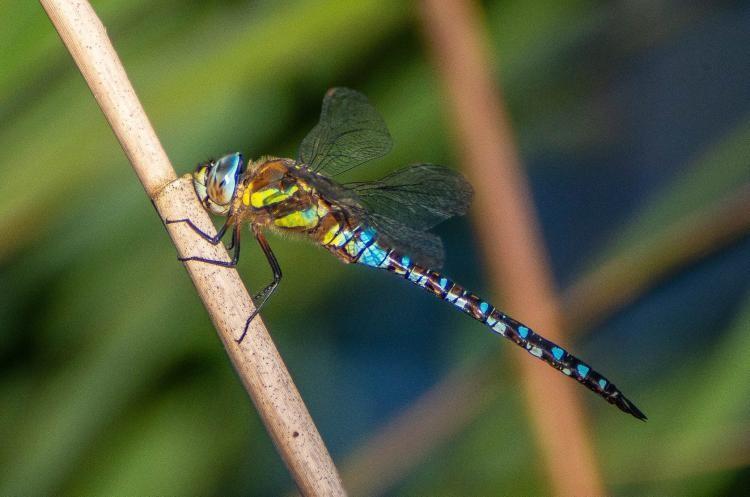
The yellow stripes on the sides of the thorax can be seen